Main

September 26, 2008

Wimsey's whimsy

One of the things about living in a foreign country is this: every so often the actual England I live in collides unexpectedly with the fictional England I grew up with. Fictional England had small, friendly villages with murders in them. It had lowering, thick fogs and grim, fantastical crimes solvable by observation and thought. It had mathematical puzzles before breakfast in a chess game. The England I live in has Sir Arthur Conan Doyle's vehement support for spiritualism, traffic jams, overcrowding, and four million people who read The Sun.

This week, at the GikIII Workshop, in a break between Internet futures, I wandered out onto a quadrangle of grass so brilliantly and perfectly green that it could have been an animated background in a virtual world. Overlooking it were beautiful, stolid, very old buildings. It had a sign: Balliol College. I was standing on the quad where, "One never failed to find Wimsey of Balliol planted in the center of the quad and laying down the law with exquisite insolence to somebody." I know now that many real people came out of Balliol (three kings, three British prime ministers, Aldous Huxley, Robertson Davies, Richard Dawkins, and Graham Greene) and that those old buildings date to 1263. Impressive. But much more startling to be standing in a place I first read about at 12 in a Dorothy Sayers novel. It's as if I spent my teenaged years fighting alongside Angel avatars and then met David Boreanaz.

Organised jointly by Ian Brown at the Oxford Internet Institute and the University of Edinburgh's Script-ed folks, GikIII (prounounced "geeky") is a small, quirky gathering that studies serious issues by approaching them with a screw loose. For example: could we control intelligent agents with the legal structure the Ancient Romans used for slaves (Andrew Katz)? How sentient is a robot sex toy? Should it be legal to marry one? And if my sexbot rapes someone, are we talking lawsuit, deactivation, or prison sentence (Fernando Barrio)? Are RoadRunner cartoons all patent applications for devices thought up by Wile E. Coyote (Caroline Wilson)? Why is The Hound of the Baskervilles a metaphor for cloud computing (Miranda Mowbray)?

It's one of the characteristics of modern life that although questions like these sound as practically irrelevant as "how many angels, infinitely large, can fit on the head of a pin, infinitely small?", which may (or may not) have been debated here seven and a half centuries ago, they matter. Understanding the issues they raise matters in trying to prepare for the net.wars of the future.

In fact, Sherlock Holmes's pursuit of the beast is metaphorical; Mowbray was pointing out the miasma of legal issues for cloud computing. So far, two very different legal directions seem likely as models: the increasingly restrictive EULAs common to the software industry, and the service-level agreements common to network outsourcing. What happens if the cloud computing company you buy from doesn't pay its subcontractors and your data gets locked up in a legal battle between them? The terms and conditions in effect for Salesforce.com warn that the service has 30 days to hand back your data if you terminate, a long time in business. Mowbray suggests that the most likely outcome is EULAs for the masses and SLAs at greater expense for those willing to pay for them.

On social networks, of course, there are only EULAs, and the question is whether interoperability is a good thing or not. If the data people put on social networks ("shouldn't there be a separate disability category for stupid people?" someone asked) can be easily transferred from service to service, won't that make malicious gossip even more global and permanent? A lot of the issues Judith Rauhofer raised in discussing the impact of global gossip are not new to Facebook: we have a generation of 35-year-olds coping with the globally searchable history of their youthful indiscretions on Usenet. (And WELL users saw the newly appointed CEO of a large tech company delete every posting he made in his younger, more drug-addled 1980s.) The most likely solution to that particular problem is time. People arrested as protesters and marijuana smokers in the 1960s can be bank presidents now; in a few years the work force will be full of people with Facebook/MySpace/Bebo misdeeds and no one will care except as something laugh at drunkenly late out in the pub.

But what Lilian Edwards wants to know is this: if we have or can gradually create the technology to make "every ad a wanted ad" - well, why not? Should we stop it? Online marketing is at £2.5 billion a year according to Ofcom, and a quarter of the UK's children spend 22 hours a week playing computer games, where there is no regulation of industry ads and where Web 2.0 is funded entirely by advertising. When TV and the Internet roll together, when in-game is in-TV and your social network merges with megamedia, and MTV is fully immersive, every detail can be personalized product placement. If I grew up five years from now, my fictional Balliol might feature Angel driving across the quad in a Nissan Prairie past a billboard advertising airline tickets.

Wendy M. Grossman's Web site has an extensive archive of her books, articles, and music, and an archive of all the earlier columns in this series. Readers are welcome to post here, at net.wars home, at her personal blog, or by email to netwars@skeptic.demon.co.uk (but please turn off HTML).

July 4, 2008

The new normal

The (only) good thing about a war is you can tell when it's over.

The problem with the "War on Terror" is that terrorism is always with us, as Liberty's director, Shami Chakrabarti, said yesterday at the Homeland and Border Security 08 conference. "I do think the threat is very serious. But I don't think it can be addressed by a war." Because, "We, the people, will not be able to verify a discernible end."

The idea that "we are at war" has justified so much post 9/11 legislation, from the ID card (in the UK) and Real ID (US) to the continued expansion of police powers.

How long can you live in a state of emergency before emergency becomes the new normal? If there is no end, when do you withdraw the latitude wartime gives a government?

Several of yesterday's speakers talked about preserving "our way of life" while countering the threat with better security. But "our way of life" is a moving target.

For example, Baroness Pauline Neville-Jones, the shadow security minister, talked about the importance of controlling the UK's borders. "Perimeter security is absolutely basic." Her example: you can't go into a building without having your identity checked. But it's not so long ago - within the 18 years I've been living in London - that you could do exactly that, even sometimes in central London. In New York, of course, until 9/11, everything was wide open; these days midtown Manhattan makes you wait in front of barriers while you're photographed, checked, and treated with great suspicion if the person you're visiting doesn't answer the phone.

Only seven years ago, flying did not involve two hours of standing in line. Until January, tourists do not have to register three days before flying to the US for pre-screening.

It's not clear how much would change with a Conservative government. "There is a very great deal by this government we would continue," said Neville-Jones. But, she said, besides trackling threats, whether motivated (terrorists) or not (floods, earthquakes, "we are also at any given moment in the game of deciding what kind of society we want to have and what values we want to preserve." She wants "sustainable security, predicated on protecting people's freedom and ensuring they have more, not less, control over their lives." And, she said, "While we need protective mechanisms, the surveillance society is not the route down which we should go. It is absolutely fundamental that security and freedom lie together as an objective."

To be sure, Neville-Jones took issue with some of the present government's plans - the Conservatives would not, she said, go ahead with the National Identity Register, and they favour "a more coherent and wide-ranging border security force". The latter would mean bringing together many currently disparate agencies to create a single border strategy. The Conservatives also favour establishing a small "homeland command for the armed forces" within the UK because, "The qualities of the military and the resources they can bring to complex situations are important and useful." At the moment, she said, "We have to make do with whoever happens to be in the country."

OK. So take the four core elements of the national security strategy according to Admiral Lord Alan West, a Parliamentary under-secretary of state at the Home Office: pursue, protect, prepare, and prevent. "Prevent" is the one that all this is about. If we are in wartime, and we know that any measure that's brought in is only temporary, our tolerance for measures that violate the normal principles of democracy is higher.

Are the Olympics wartime? Security is already in the planning stages, although, as Tarique Ghaffur pointed out, the Games are one of several big events in 2012. And some events like sailing and Olympic football will be outside London, as will 600 training camps. Add in the torch relay, and it's national security.

And in that case, we should be watching very closely what gets brought in for the Olympics, because alongside the physical infrastructure that the Games always leave behind - the stadia and transport - may be a security infrastructure that we wouldn't necessarily have chosen for daily life.

As if the proposals in front of us aren't bad enough. Take for example, the clause of the counterterrorism bill (due for its second reading in the Lords next week) that would allow the authorities to detain suspects for up to 42 days without charge. Chakrabarti lamented the debate over this, which has turned into big media politics.

"The big frustration," she said, "is that alternatives created by sensible, proportionate means of early intervention are being ignored." Instead, she suggested, make the data legally collected by surveillance and interception admissible in fair criminal trials. Charge people with precursor terror offenses so they are properly remanded in custody and continue the investigation for the more serious plot. "That is a way of complying with ancient principles that you should know what you are accused of before being banged up, but it gives the police the time and powers they need."

Not being at war gives us the time to think. We should take it.

Wendy M. Grossman's Web site has an extensive archive of her books, articles, and music, and an archive of all the earlier columns in this series. Readers are welcome to post here, at net.wars home, at her personal blog, or by email to netwars@skeptic.demon.co.uk (but please turn off HTML).

May 30, 2008

Ten

It's easy to found an organization; it's hard to keep one alive even for as long as ten years. This week, the Foundation for Information Policy Research celebrated its tenth birthday. Ten years is a long time in Internet terms, and even longer when you're trying to get government to pay attention to expertise in a subject as difficult as technology policy.

My notes from the launch contain this quote from FIPR's first director, Caspar Bowden, which shows you just how difficult FIPR's role was going to be: "An educational charity has a responsibility to speak the truth, whether it's pleasant or unpleasant." FIPR was intended to avoid the narrow product focus of corporate laboratory research and retain the traditional freedoms of an academic lab.

My notes also show the following list of topics FIPR intended to research: the regulation of electronic commerce; consumer protection; data protection and privacy; copyright; law enforcement; evidence and archiving; electronic interaction between government, businesses, and individuals; the risks of computer and communications systems; and the extent to which information technologies discriminate against the less advantaged in society. Its first concern was intended to be researching the underpinnings of electronic commerce, including the then recent directive launched for public consultation by the European Commission.

In fact, the biggest issue of FIPR's early years was the crypto wars leading up to and culminating in the passage of the Regulation of Investigatory Powers Act (2000). It's safe to say that RIPA would have been a lot worse without the time and energy Bowden spent listening to Parliamentary debates, decoding consultation papers, and explaining what it all meant to journalists, politicians, civil servants, and anyone else who would listen.

Not that RIPA is a fountain of democratic behavior even as things are. In the last couple of weeks we've seen the perfect example of the kind of creeping functionalism that FIPR and Privacy International warned about at the time: the Poole council using the access rules in RIPA to spy on families to determine whether or not they really lived in the right catchment area for the schools their children attend.

That use of the RIPA rules, Bowden said at at FIPR's half-day anniversary conference last Wednesday, sets a precedent for accessing traffic data for much lower level purposes than the government originally claimed it was collecting the data for. He went on to call the recent suggestion that the government may be considering a giant database, updated in real time, of the nation's communications data "a truly Orwellian nightmare of data mining, all in one place."

Ross Anderson, FIPR's founding and current chair and a well-known security engineer at Cambridge, noted that the same risks adhere to the NHS database. A clinic that owns its own data will tell police asking for the names of all its patients under 16 to go away. "If," said Anderson, "it had all been in the NHS database and they'd gone in to see the manager of BT, would he have been told to go and jump in the river? The mistake engineers make too much is to think only technology matters."

That point was part of a larger one that Anderson made: that hopes that the giant databases under construction will collapse under their own weight are forlorn. Think of developing Hulk-Hogan databases and the algorithms for mining them as an arms race, just like spam and anti-spam. The same principle that holds that today's cryptography, no matter how strong, will eventually be routinely crackable means that today's overload of data will eventually, long after we can remember anything we actually said or did ourselves, be manageable.

The most interesting question is: what of the next ten years? Nigel Hickson, now with the Department of Business, Enterprise, and Regulatory Reform, gave some hints. On the European and international agenda, he listed the returning dominance of the large telephone companies on the excuse that they need to invest in fiber. We will be hearing about quality of service and network neutrality. Watch Brussels on spectrum rights. Watch for large debates on the liability of ISPs. Digital signatures, another battle of the late 1990s, are also back on the agenda, with draft EU proposals to mandate them for the public sector and other services. RFID, the "Internet for things" and the ubiquitous Internet will spark a new round of privacy arguments.

Most fundamentally, said Anderson, we need to think about what it means to live in a world that is ever more connected through evolving socio-technological systems. Government can help when markets fail; though governments themselves seem to fail most notoriously with large projects.

FIPR started by getting engineers, later engineers and economists, to talk through problems. "The next growth point may be engineers and psychologists," he said. "We have to progressively involve more and more people from more and more backgrounds and discussions."

Probably few people feel that their single vote in any given election really makes a difference. Groups like FIPR, PI, No2ID, and ARCH remind us that even a small number of people can have a significant effect. Happy birthday.


Wendy M. Grossman's Web site has an extensive archive of her books, articles, and music, and an archive of all the earlier columns in this series. Readers are welcome to post here, at net.wars home, at her personal blog, or by email to netwars@skeptic.demon.co.uk (but please turn off HTML).


May 2, 2008

Bet and sue

Most net.wars are not new. Today's debates about free speech and censorship, copyright and control, nationality and disappearing borders were all presaged by the same discussions in the 1980s even as the Internet protocols were being invented. The rare exception: online gambling. Certainly, there were debates about whether states should regulate gambling, but a quick Usenet search does not seem to throw up any discussions about the impact the Internet was going to have on this particular pastime. Just sex, drugs, and rock 'n' roll.

The story started in March, when the French Tennis Federation (FFT - Fédération Française de Tennis) filed suit in Belgium against Betfair, Bwin, and Ladbrokes to prevent them from accepting bets on matches played at the upcoming French Open tennis championships, which start on May 25. The FFT's arguments are rather peculiar: that online betting stains the French Open's reputation; that only the FFT has the right to exploit the French Open; that the online betting companies are parasites using the French Open to make money; and that online betting corrupts the sport. Bwin countersued for slander.

On Tuesday of this week, the Liège court ruled comprehensively against the FFT and awarded the betting companies costs.

The FFT will still, of course, control the things it can: fans will be banned from using laptops and mobile phones in the stands. The convergence of wireless telephony, smart phones, and online sites means that in the second or two between the end of a point and the electronic scoreboard updating, there's a tiny window in which people could bet on a sure thing. Why this slightly improbable scenario concerns the FFT isn't clear; that's a problem for the betting companies. What should concern the FFT is ensuring a lack of corruption within the sport. That means the players and their entourages.

The latter issue has been a touchy subject in the tennis world ever since last August, when Russian player Nikolay Davydenko, currently fourth in the world rankings, retired in the third and final set of a match in Poland against 87th ranked Marin Vassallo Arguello, citing a foot injury. Davydenko was accused of match-fixing; the investigation still drags on. In the resulting publicity, several other players admitted being approached to fix matches. As part of subsequent rule-tightening by the Association of Tennis Professionals, the governing body of men's professional tennis, three Italian players were suspended briefly late last year for betting on other players' matches.

Probably the most surprising thing is that tennis, along with soccer and horse racing, is actually among the most popular sports for betting. A minority sport like tennis? Yet according to USA Today, the 2007 Paris Masters event saw $750 million to $1.5 billion in bets. I can only assume that the inverted pyramid of matches every week involving individual players fits well with what bettors like to do.

Fixing matches seems even more unlikely. The best payouts come from correctly picking upsets, the bigger the better. But top players are highly unlikely to throw matches to order. Most of them play a relatively modest number of events (Davydenko is admittedly the exception) and need all the match wins and points from those events to sustain their rankings. Plus, they're just too damn rich.

In 2007, Roger Federer, the ultra-dominant number one player since the end of 2003, earned upwards of $10 million in prize money alone; Davydenko picked up over $2 million (and has already won another $1 million in 2008). All of the top 12 earned over $1 million. Add in endorsements, and even after you subtract agents' fees, tax, and travel costs for self and entourage, you're still looking at wealthy guys. They might tank matches at events where they're being paid appearance fees (which are legal on the men's tour at all but the top 14 events, but proving they've done so is exceptionally difficult. Fixing matches, which could cost them in lost endorsements on top of the tour's own sanctions, surely can't be worth it.

There are several ironies about the FFT's action. First of all (something most of the journalists covering this story don't mention, probably because they don't spend a lot of time watching tennis on TV), Bwin has been an important advertiser sponsoring tennis on Eurosport. It's absolutely typical of the counter-productive and intricately incestuous politics that characterize the tennis world that one part of the sport would sue someone who pays money into another part of the sport.

Second of all, as Betfair and Bwin pointed out, all three of these companies are highly regulated European licensed operations. Ruling them out of action would mean shift online betting to less well regulated offshore companies. They also pointed out the absurdity of the parasites claim: how could they accept bets on an event without using its name? Betfair in particular documented its careful agreements with tennis's many governing bodies.

Third of all, the only reason match-fixing is an issue in the tennis world right now is that Betfair spotted some unusual betting patterns during that Polish Davydenko match, cancelled all the bets, and went public with the news. Without that, Davydenko would have avoided the fight over his family's phone records. Come to think of it, making the issue public probably explains the FFT's behavior: it's revenge.


Wendy M. Grossman's Web site has an extensive archive of her books, articles, and music, and an archive of all the earlier columns in this series. Readers are welcome to post here, at net.wars home, at her personal blog, or by email to netwars@skeptic.demon.co.uk (but please turn off HTML).

April 4, 2008

Million-dollar baby


The first time I saw James Randi he was hauling a load of fresh chicken guts out of a guy's stomach.

Of course, in my eagerness to make it sound like a good story I've jazzed that up a bit. The chicken guts were real and the guy's stomach was real (he was an innocent audience member who'd been recruited for the purpose of demonstration), but the pull-outage was clever sleight-of-hand. The year was 1982 and the occasion was a lecture demonstration at Cornell University. The point was demonstrating how "psychic surgeons" achieve their effects.

The next time I'll see James Randi is on April 19, when he's giving a talk at Conway Hall, in London. I don't think chicken guts will be involved, though a number of other prominent skeptics will also be speaking and you just never know.

It was Randi's ability to demonstrate plausible explanations for the apparently inexplicable that blew me away on that particular day. A lot of people like to claim that skeptics are closed-minded, but in fact it seems to me that the key to skepticism is tolerance of uncertainty and patience. A skeptic sitting in an empty house and hearing inexplicable creaking thinks, "I wonder what that is." A believer thinks, "Must be a ghost." Randi never claimed to be able to explain everything, but he went a long way toward showing me that things that friends thought must be inexplicable might still have natural explanations if you had the patience to wait to find out what they were and the right kind of mind to. A lie goes round the world while the truth is still putting its boots on; it takes seconds to claim something's paranormal but years of research to find out the truth.

One of the sad things about science these days is that so many disciplines require so much expensive equipment and funding that it's hard for an amateur to make much of a contribution. There are, to be sure, exceptions: some friends on Crete were successful in finding the nests of griffin vultures and did a lot of work keeping count, and anyone can look for fossils and hope to fill in a gap in the record. But few can afford their own radio telescope, particle collider, or climate modelling supercomputer. Randi showed that amateurs with a particular bent - a knowledge of stage magic and deception - were more effective at assessing paranormal claims than many scientists.

None of this would qualify Randi as a subject for net.wars except that recently he's been the subject of Usenet spam. Most people who do not participate in Usenet are under the impression that all newsgroups drowned under email levels of spam long ago. But in fact until the last month, when the Chinese apparently discovered Usenet, spam levels have been negligible for quite a few years now. Once Web boards, blogs, and social networks got going Usenet became even more of a minority pastime than it was in its heyday. Spamming Usenet doesn't cost much, but why bother when the audience is relatively tiny?

But people who want to boast that they've bested James Randi apparently want to lump themselves in with ads for cheap knockoffs of Nike shoes, Breitling watches, and Prada handbags. And so a version of this message began popping up randomly. It is, of course, all over the Net by now, and there's not a lot anyone can do other than debunk it and hope someone notices.
To deal with the most trivial bit, the bit that asks if James Randi is "even a real name". Well, it's not the name Randi was born with, although it's a modification of his first and middle names. But he's been using it consistently for something over 50 years, and it is his legal name. So it's real enough for all intents and purposes.

The million-dollar challenge was a relative newcomer that had its origins in a similar $10,000 challenge that Randi had going for more than 30 years. The increased money made the challenge a much juicier story, of course. But as this rational game theoryish analysis of the challenge makes clear, the challenge was only ever likely to attract the deluded. As I understand it, the mailbag got ridiculous in both size and content. There's plenty of evidence for that; the apparent basis of the claim that Randi was beaten is impenetrable. It is true, though, that until the beginning of this year the challenge rules stated that the prize would continue to be offered until it was awarded, including after Randi's death. Now, it ends March 6, 2010. (Get your claim in now!)

The end of the challenge is the end of an era for skeptics. For years, if any paranormal claimant was particularly insistent that he could dowse for oil or read minds we could say, "If you're so psychic, why ain't you taking Randi's challenge?" Now, my god - we're going to have to think of new stuff to say.

Meantime, come watch Randi in person and find out about the kinds of tests he's been doing all these years.

Wendy M. Grossman's Web site has an extensive archive of her books, articles, and music, and an archive of all the earlier columns in this series. Readers are welcome to post here, at net.wars home, at her personal blog, or by email to netwars@skeptic.demon.co.uk (but please turn off HTML).

March 28, 2008

Leaving Las Vegas

Las Vegas shouldn't exist. Who drops a sprawling display of electric lights with huge fountains and luxury hotels that into the best desert scenery on the planet during an energy crisis? Indoors, it's Britain in mid-winter; outdoors you're standing in a giant exhaust fan. The out-of-proportion scale means that everything is four times as far away as you think, including the jackpot you're not going to win at one of its casinos. It's a great place to visit if you enjoy wallowing in self-righteous disapproval.

This all makes it the stuff of song, story, and legend and explains why Jeff Jonas's presentation at etech was packed.

The way Jonas tells it in his blog and at his presentation, he got into the gaming industry by driving through Las Vegas in 1989 idly wondering what was going on behind the scenes at the casinos. A year later he got the tiny beginnings of an answer when he picked up a used couch he'd found in the newspaper classified ads (boy, that dates it, doesn't it?) and found that its former owner played blackjack "for a living". Jonas began consulting to the gaming industry in 1991, helping to open Treasure Island, Bellagio, and Wynn.

"Possibly half the casinos in the world use technology we created," he said at etech.

Gaming revenues are now less than half of total revenues, he said, and despite the apparent financial win they might represent problem gamblers are in fact bad for business. The goal is for people to have fun. And because of that, he said, a place like the Bellagio is "optimized for consumer experience over interference. They don't want to spend money on surveillance."

Jonas began with a slide listing some common ideas about how Las Vegas works, culled from movies like Ocean's 11 and the TV show Las Vegas. Does the Bellagio have a vault? (No.) Do casinos perform background checks on guests based on public records? (No.) Is there a gaming industry watch list you can put yourself on but not take yourself off? (Yes, for people who know they have a gambling addiction.) Do casinos deliberately hire ex-felons? (Yes, to rehabilitate them.) Do they really send private jets for high rollers? (Cue story.)

There was, he said, a casino high roller who had won some $18 million. A win like that is going to show up in a casino's quarterly earnings. So, yes, they sent a private jet to his town and parked a limo in front of his house for the weekend. If you've got the bug, we're here for you, that kind of thing. He took the bait, and lost $22 million.

Do they help you create cover stories? (Yes.) "What happens in Vegas stays in Vegas" is an important part of ensuring that people can have fun that does not come back to bite them when they go home. The casinos' problem is with identity, not disguises, because they are required by anti-money laundering rules to report it any time someone crosses the $10,000 threshold for cash transactions. So if you play at several different tables, then go upstairs and change disguises, and come back and play some more, they have to be able to track you through all that. ID, therefore, is extremely important. Disguises are welcome; fake ID is not.

Do they use facial recognition to monitor the doors to spot cheaters on arrival? (Well...)

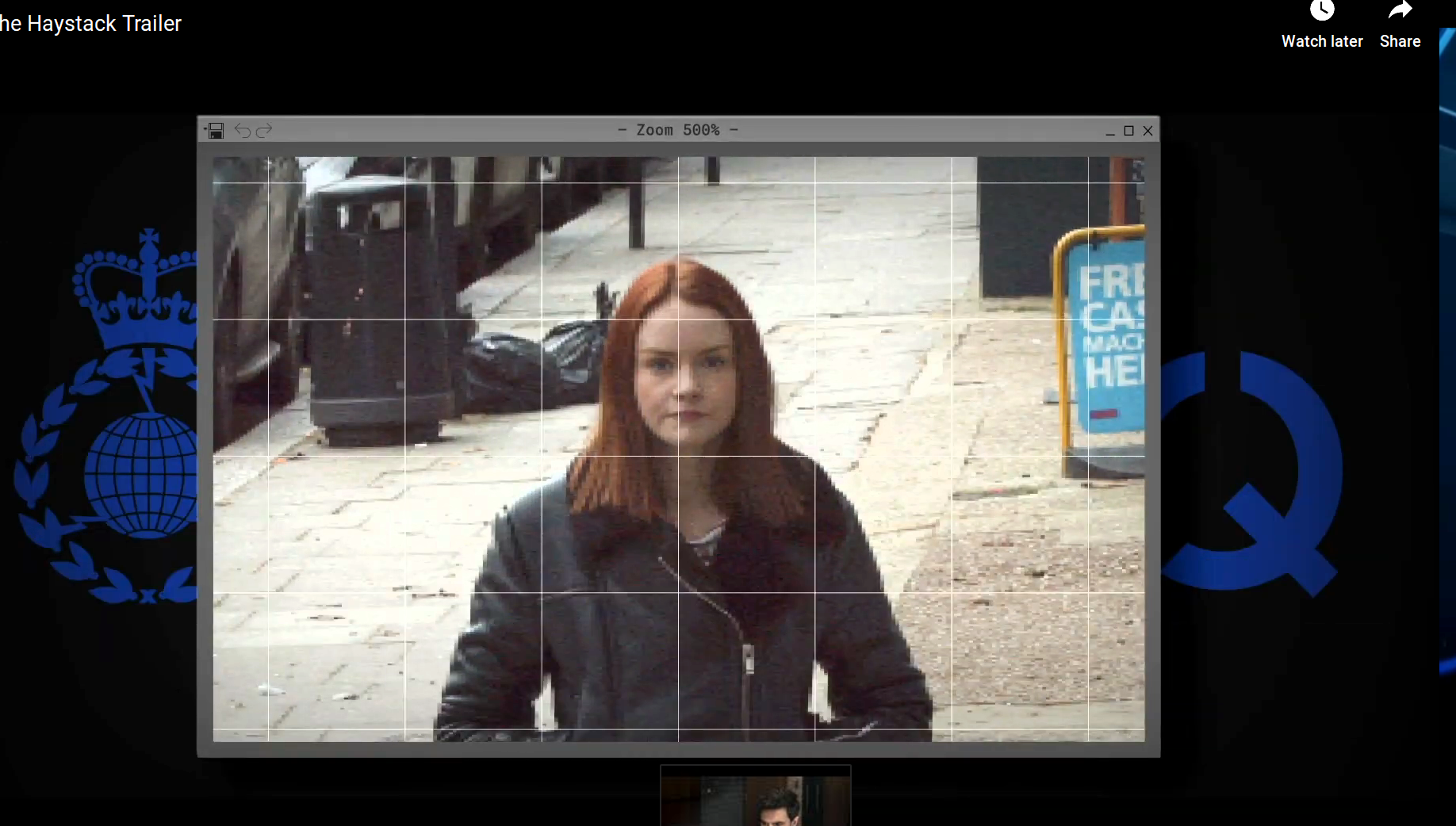
Of course technology-that-is-indistinguishable-from-magic-because-it-actually-is-magic appears on every crime-solving TV show these days. You know, the stuff where Our Heroes start with a fuzzy CCTV image and they punch in on a tiny piece of it and blow it up. And then someone says, "Can you enhance that?" and someone else says, "Oh, yes, we have new software," and a second later a line goes down the picture filling in detail. And a second after that you can read the brand on the face of a wrist watch (Numb3rs or the manufacturer's coding on a couple of pills (Las Vegas. Or they have a perfect matching system that can take a partial fingerprint lifted off a strand of hair or something and bang! the database can find not only the person's identity but their current home address and phone number (Bones). And who can ever forget the first episode of 24, when Jack Bauer, alarmed at the disappearance of his daughter, tosses his phone number to an underling and barks, "Find me all the Internet passwords associated with this phone number."

And yet...a surprising number of what ought to be the technically best-educated audience on the planet thought facial recognition was in operation to catch cheaters. Folks, it doesn't work in airports, either.

Which is the most interesting thing Jonas said: he now works for IBM (which bought his company) on privacy and civil liberties issues, including work on software to help the US government spot terrorists without invading privacy. It's an interesting concept, partly because security at airports and other locations is now so invasive. But also because if Las Vegas can find a way to deploy surveillance such that only the egregious problems are caught and everyone else just has a good time...why can't governments?

Wendy M. Grossman's Web site has an extensive archive of her books, articles, and music, and an archive of all the earlier columns in this series. Readers are welcome to post here, at net.wars home, at her personal blog, or by email to netwars@skeptic.demon.co.uk (but please turn off HTML).

March 21, 2008

Copywrongs

This is a shortened version of a talk I gave at Musicians, Fans, and Copyright at the LSE on Wednesday, March 19, 2008.

Most discussions about copyright with respect to music do not include musicians. The notable exception is the record companies' trophy musicians who appear at government hearings. Because these tend to be the most famous and well-rewarded musicians they can find, their primarily contribution to the dabate seems to be to try to make politicians think, "We love you, we can't bear that you should starve, the record company must be right." It's a long time since I made a living playing, so I can't pretend to represent them. But I can make a few observations. Folk musicians in particular stand at the nexus of all the copyright arguments: they are contemporary artists and songwriters, but they mine their material from the public domain.

Every musician, at every level of the business, has been ripped off (PDF), usually when they can least afford it. The result is that they tend to be deeply suspicious of any attempt to limit their rights. The music business has such a long history of signing the powerless - young, inexperienced musicians, the black blues musicians of the Mississippi Delta, and many others - to exploitive contracts that it's hard to understand why they're still allowed to get away with it. Surely it ought to be possible to limit what rights and terms the industry can dictate to the inexperienced and desperate with stars in their eyes?

Steve Gillette, author with Tom Campbell of the popular 1966 song "Darcy Farrow", says that when Ian & Sylvia wanted to record the song, they were told to hire someone to collect royalties on their behalf. That person did little to collect royalties for many years. Gillette and Campbell eventually won a court judgement with a standard six-month waiting period - during which time John Denver recorded the song and put it on his best-selling album, Rocky Mountain High, giving the publisher a motive to fight back. They were finally able to wrest back control of the song in about 1990.

In book publishing it is commonplace for the rights to revert to authors if and when the publisher decides to withdraw their work from sale. There is no comparable practice in the music business. And so, people I know on the folk scene whose work has gone out of commercial release find themselves in the situation where their fans want to buy their music but they can't sell it. As one musician said, "I didn't work all those years to have my music stuck in a vault."

Pete Coe, a traditional performer and songwriter, tells me that the common scenario is that a young musician signs a recording contract early on, and then the company goes out of business and the recordings are bought by others. The purchasing company buys the assets - the recordings - but not the burden, the obligation to pass on royalties to the original artists. Coe himself, along with many others, is in this situation; some of his early recordings have been through two such bankruptcies. The company that owns them now owns many other folk releases of the period and either refuses to re-release the recordings or refuses to provide sales figures or pay royalties, and is not a member of MCPS. Coe points out that this company would certainly refuse to cooperate with any effort to claim the reversion of rights.

In a similar case, Nic Jones, a fine and widely admired folk guitarist who played almost exclusively traditional music, was in a terrible car accident in about 1981 that left him unable to play. Over the following years his recordings were bought up but not rereleased, so that an artist now unable to work could not benefit from his back catalogue. It is only in the last few years, with the cost of making and distributing music falling, that he and his wife have managed to release old live recordings on their own label. Term extension would, if anything, hurt Jones's ability to regain control over and exploit his own work. (Note: I have not canvassed Jones's opinion.)

The artists in these cases, like any group of cats, have reacted in different ways. Gillette, who comments also that in general it's the smaller operators who are the biggest problem, says, that term extension "only benefits the corporate media, and in my experience only serves to lend energy to turning the public trust into company assets".

Coe, on the other hand, favors term extension. "We determined," he said by email in 2006, "that once we'd regained our rights, publishing and recording, that they were never again to pass out of our control."

Coe's reaction is understandable. But I think many problems could be solved by forcing the industry to treat musicians and artists more fairly. It's notable that folk artists, through necessity, pioneered what's becoming commonplace now: releasing their own albums to sell to audiences direct at their gigs and via mail, now Web, order.

What the musicians of the future want and need, in my opinion, is the same thing that the musicians of the present and past wanted: control. In my view, there is no expansion of copyright that will give it to them.


Wendy M. Grossman's Web site has an extensive archive of her books, articles, and music, and an archive of all the earlier columns in this series. Readers are welcome to post here, at net.wars home, at her personal blog, or by email to netwars@skeptic.demon.co.uk (but please turn off HTML).

March 7, 2008

Techitics

This year, 2008, may go down in history as the year geeks got politics. At etech this week I caught a few disparaging references to hippies' efforts to change politics. Which, you know, seemed kind of unfair, for two reasons. First: the 1960s generation did change an awful lot of things, though not nearly as many as they hoped. Second: a lot of those hippies are geeks now.

But still. Give a geek something that's broken and he'll itch to fix it. And one thing leads to another. Which is why on Wednesday night Lawrence Lessig explained in an hour-long keynote that got a standing ovation how he plans to fix what's wrong with Congress.

No, he's not going to run. Some 4,500 people on Facebook were trying to push him into it, and he thought about it, but preliminary research showed that his chances of beating popular Silicon Valley favorite, Jackie Speier, were approximately zero.

"I wasn't afraid of losing," he said, noting ruefully that in ten years of copyfighting he's gotten good at it. Instead, the problem was that Silicon Valley insiders would have known that no one was going to beat Jackie Speier. But outsiders would have pointed, laughed, and said, "See? The idea of Congressional reform has no legs." And on to business as usual. So, he said, counterproductive to run.

Instead, he's launching Change Congress. "Obama has taught us that it's possible to imagine many people contributing to real change."

The point, he said, will be to provide a "signalling function". Like Creative Commongs, Change Congress will give candidates an easy way to show what level of reform they're willing to commit tto. The system will start with three options: 1) refusing money from lobbyists and political action committees (private funding groups); 2) ban earmarks (money allocated to special projects in politicians' home states); 3) commit to public financing for campaigns. Candidates can then display the badge generated from those choices on their campaign materials.

From there, said Lessig, layer something like Emily's List on top, to help people identify candidates they're willing to suppot with monthly donations, thereby subsidizing reform.

Money, he admitted, isn't the entire problem. But, like drinking for an alcoholic, it's the first problem you must solve to be able to tackle any of the others with any hope of success.

In a related but not entirely similar vein, the guys who brought us They Work For You nearly four years ago are back with UN democracy, an attempt to provide a signalling function to the United Nations> by making it easy to find out how your national representatives are voting in UN meetings. The driving force behind UNdemocracy.com is Liverpool's Julian Todd, who took the UN's URL obscurantism as a personal challenge. Since he doesn't fly, presenting the new service were Tom Loosemore, Stefan Mogdalinski, and Danny O'Brien, who pointed out that when you start looking at the decisions and debates you start to see strange patterns: what do the US and Israel have in common with Palau and Micronesia?

The US Congress and the British Parliament are all, they said, now well accustomed to being televised, and their behaviour has adapted to the cameras. At the UN, "They don't think they're being watched at all, so you see horse trading in a fairly raw form."

The meta-version they believe can be usefully and widely applied: 1) identify broken civic institution; 2) liberate data from said institution. There were three more ingredients, but they vanished the slide too quickly. But Mogdalinski noted that where in the past they have said "Ask forgiveness, not permission", alluding to the fact that most institutions if approached will behave as though they own the data. He's less inclined to apologise now. After all, isn't it *our* data that's being released in the public interest?

Data isn't everything. But the Net community has come a long way since the early days, when the prevailing attitude was that technological superiority would wash away politics-as-usual by simply making an end run around any laws governments tried to pass. Yes, technology can change the equation a whole lot. For example, once PGP escaped laws limiting the availability of strong encryption were pretty much doomed to fail (though not without a lot of back-and-forth before it became official). Similarly, in the copyright wars it's clear that copyrighted material will continue to leak out no matter how hard they try to protect it.

But those are pretty limited bits of politics. Technology can't make such an easy end run around laws that keep shrinking the public domain. Nor can it by itself solve policies that deny the reality of global climate change or that, in one of Lessig's examples, back government recommendations off from a daily caloric intake of 10 percent sugar to one of 25 percent. Or that, in another of his examples, kept then Vice-President Al Gore from succeeding with a seventh part to the 1996 Communications Act deregulating ADSL and cable because without anything to regulate what would Congressmen do without the funds those lobbyists were sending their way? Hence, the new approach.

"Technology," Lessig said, "doesn't solve any problems. But it is the only tool we have to leverage power to effect change."

Wendy M. Grossman's Web site has an extensive archive of her books, articles, and music, and an archive of all the earlier columns in this series. Readers are welcome to post here, at net.wars home, at her | | Comments (0) | TrackBacks (0)

November 23, 2007

Road block

There are many ways for a computer system to fail. This week's disclosure that Her Majesty's Revenue and Customs has played lost-in-the-post with two CDs holding the nation's Child Benefit data is one of the stranger ones. The Child Benefit database includes names, addresses, identifying numbers, and often bank details, on all the UK's 25 million families with a child under 16. The National Audit Office requested a subset for its routine audit; the HMRC sent the entire database off by TNT post.

There are so many things wrong with this picture that it would take a village of late-night talk show hosts to make fun of them all. But the bottom line is this: when the system was developed no one included privacy or security in the specification or thought about the fundamental change in the nature of information when paper-based records are transmogrified into electronic data. The access limitations inherent in physical storage media must be painstakingly recreated in computer systems or they do not exist. The problem with security is it tends to be inconvenient.

With paper records, the more data you provide the more expensive and time-consuming it is. With computer records, the more data you provide the cheaper and quicker it is. The NAO's file of email relating to the incident (PDF) makes this clear. What the NAO wanted (so it could check that the right people got the right benefit payments): national insurance numbers, names, and benefit numbers. What it got: everything. If the discs hadn't gotten lost, we would never have known.

Ironically enough, this week in London also saw at least three conferences on various aspects of managing digital identity: Digital Identity Forum, A Fine Balance, and Identity Matters. All these events featured the kinds of experts the UK government has been ignoring in its mad rush to create and collect more and more data. The workshop on road pricing and transport systems at the second of them, however, was particularly instructive. Led by science advisor Brian Collins, the most notable thing about this workshop is that the 15 or 20 participants couldn't agree on a single aspect of such a system.

Would it run on GPS or GSM/GPRS? Who or what is charged, the car or the driver? Do all roads cost the same or do we use differential pricing to push traffic onto less crowded routes? Most important, is the goal to raise revenue, reduce congestion, protect the environment, or rebalance the cost of motoring so the people who drive the most pay the most? The more purposes the system is intended to serve, the more complicated and expensive it will become, and the less likely it is to answer any of those goals successfully. This point has of course also been made about the National ID card by the same sort of people who have warned about the security issues inherent in large databases such as the Child Benefit database. But it's clearer when you start talking about something as limited as road charging.

For example: if you want to tag the car you would probably choose a dashboard-top box that uses GPS data to track the car's location. It will have to store and communicate location data to some kind of central server, which will use it to create a bill. The data will have to be stored for at least a few billing cycles in case of disputes. Security services and insurers alike would love to have copies. On the other hand, if you want to tag the driver it might be simpler just to tie the whole thing to a mobile phone. The phone networks are already set up to do hand-off between nodes, and tracking the driver might also let you charge passengers, or might let you give full cars a discount.

The problem is that the discussion is coming from the wrong angle. We should not be saying, "Here is a clever technological idea. Oh, look, it makes data! What shall we do with it?" We should be defining the problem and considering alternative solutions. The people who drive most already pay most via the fuel pump. If we want people to drive less, maybe we should improve public transport instead. If we're trying to reduce congestion, getting employers to be more flexible about working hours and telecommuting would be cheaper, provide greater returns, and, crucially for this discussion, not create a large database system that can be used to track the population's movements.

(Besides, said one of the workshop's participants: "We live with the congestion and are hugely productive. So why tamper with it?")

It is characteristic of our age that the favored solution is the one that creates the most data and the biggest privacy risk. No one in the cluster of organisations opposing the ID card - No2ID, Privacy International, Foundation for Information Policy Research, or Open Rights Group - wanted an incident like this week's to happen. But it is exactly what they have been warning about: large data stores carry large risks that are poorly understood, and it is not enough for politicians to wave their hands and say we can trust them. Information may want to be free, but data want to leak.

Wendy M. Grossman’s Web site has an extensive archive of her books, articles, and music, and an archive of all the earlier columns in this series. Readers are welcome to post here, at net.wars home, at her personal blog, or by email to netwars@skeptic.demon.co.uk (but please turn off HTML).

November 3, 2007

Amateur hour

If you really want to date yourself, admit that you remember Ted Mack's Amateur Hour. Running from 1949 to 1970, it was the first televised amateur talent competition, the granddaddy of today's reality TV. What's new about the Internet isn't that amateurs can create content people will look at but the ability to access an audience without going through an older-media gatekeeper.

But even on the Internet, user-generated content (as the kids are calling it these days) is not new: user-uploaded messages and files are how people like CompuServe made money. But that was user-originated content. Today's user-generated content on sites like YouTube includes a mass of uploaded video, audio, and text that in fact do not belong to the users but to third parties. These issues are contentious; so much so that Ian Fletcher, the CEO of he UK's Intellectual Property Office, bailed at the thought of appearing before an audience that might publish his remarks out of context on the Net.

To hear media representatives tell it at today's Amateur Hour conference, they regarded it with a pretty benign eye for quite a while.

It wasn't, said Lisa Stancati, assistant general counsel for ESPN, until Google bought YouTube that everyone got mad. "If Google is going to be making money from my content I have a serious problem with that."

Well, fair enough. But how did it get to be your content? Media companies love theoretically paying artists when they want to expand copyright. Come contract time it's a different story, as the tableful from Actors Equity knew all too well. And what about the content of the future?

Marni Pedorella, vice president of NBC Universal, notes that the site the company runs for Battlestar Galactica fans provides raw materials for users to play with. If they upload the mashed-up results, however, NBC takes a royalty-free license in perpetuity. Are older media hoping new media will become a source of what Brian Murphy is calling CGC – for "cheaply generated content". Like reality TV?

Heather Moosnick, vice president of business development for CBS Interactive, recounted CBS's moves to share its content more widely around the Net: you can watch current shows on its Web site, for example (unless you live outside the US). But, she said sadly, if people don't care about copyright – well, there might be fewer CSIs. (Threat or promise? There are three CSI shows. At least she didn't say that less "expert content" will deprive us of Cavemen.)

Because the conference was sponsored by a law school, a lot of the moderators' questions centered on things like: How do you see your risks developing? What is your liability? What about international laws?

And: what is the difference between a professional and an amateur? You might argue that it doesn't matter as long as the content is interesting, but when it comes to the shield laws that allow journalists to protect their sources the difference is important. Should every blogger – hundreds of millions of them – have the right ? Just the ones with mass audiences who make a living from running AdSense alongside their postings? None? Is a blogger with an audience of 100,000 of the most important people in American politics more or less worthy of protection than a guy writing for a local paper with a circulation of 10,000? Is a fan taking pictures of Lindsay Lohan with a cell phone subject to California's new law limiting paparazzi?

To me, the key difference between an amateur and a professional is that the professional does the job even when he doesn't feel like it.

The source of this idea is Agatha Christie, who defined the moment she became a professional writer, some ten or 15 books into her career. She was mid-divorce, and she liked neither the book nor her work on it – but she had a contract. The amateur can say, Screw the contract, I don't feel like getting up this morning. The professional makes the work arrive, even if it stinks. Unfortunately, that practical distinction is not easily describable in law.

You could define it a different way: a professional is the guy you'll miss if he goes on strike, as TV writers are about to do over residual payments for digital reuse.

Another line: a lot of large companies operate their message boards on the basis of the safe harbor protections in the DMCA, under which you're not liable as long as you take down material when notified of infringement or other legal problems. What about mixed content? There's a case pending between the Fair Housing Council and Roommates.com because the latter site gave users a questionnaire asking such roommate-compatibility questions as age, race, gender, sexual orientation… All these are questions that landlords are not allowed to ask under the Fair Housing Act. At what point is someone looking for a roommate subject to that act? Are we really going to refuse to allow people all control over who they live with?

These aren't problems that have solutions, at least yet. They're the user-generated lawsuits of the future.

Wendy M. Grossman’s Web site has an extensive archive of her books, articles, and music, and an archive of all the earlier columns in this series. Readers are welcome to post here, at net.wars home, at her personal blog, or by email to netwars@skeptic.demon.co.uk (but please turn off HTML).

October 26, 2007

Tomorrow's world

"It's like 1994," Richard Bartle, the longest-serving virtual world creator, said this week. We were at the Virtual Worlds Forum. Sure enough: most of the panels were about how businesses could make money! in virtual worlds! Substitute Web! and Bartle was right.

"Virtual worlds are poised to revolutionize today's Web ecommerce," one speaker said enthusiastically. "They will restore to ecommerce the social and recreational aspect of shopping, the central element in the real world, which was stripped away when retailers went online."

There's gold in them thar cartoon hills.

But which hills? Second Life is, to be sure, the virtual world du jour, and it provides the most obviously exploitable platform for businesses. But in 1994 so did CompuServe. It was only three years later – ten years ago last month – that it had shrunk sufficiently for AOL to buy it as revenge. In turn, AOL is itself shrinking – its subscription revenues for the quarter ending June 30, 2007 were half those in the same quarter in 2006.

If there is one thing we know about Internet communities it's that they keep reforming in new technologies, often with many of the same people. Today's kids bop from world to world in groups, every few months. The people I've known on CIX or the WELL turn up on IRC, LiveJournal, Facebook, and IM. Sometimes you flee, as Corey Bridges said of social networks, because your friends list has become "crufted" up with people you don't like. You take your real friends somewhere else until mutatis mutandem. In the older text-based conferencing systems, same pattern: public conferences filled with too many annoying people joined sent old-timers to gated communities like mailing lists or closed conferences. And so it goes.

In a post pointed at by the VWF blog Metaversed's Nick Wilson defines social virtual worlds and concludes that there are only eight of them – the rest are not yet available to the general public, children's worlds, or simply development platforms. "The virtual worlds space," he concludes, "is not as large as many people think."

Probably anyone who's tried to come to grips with Second Life, number one on Wilson's list, without the benefit of friends to go there with knows that. Many parts of SL are resoundingly empty much of the time, and it seems inarguable that most of SL's millions of registered users try it out a few times and then leave their avatars as records in the database. Nonetheless, companies keep experimenting and find the results valuable. A batch of Italian IBMers even used the world to stage a strike last month. Naturally it crashed IBM's SL Business Center: the 1,850 strikers were spread around seven IBM locations, but you can only put about 50 avatars on an island before server lag starts to get you. Strikes: the original denial-of-service attacks.

But questioning whether there's a whole lot of there there is a nice reminder that in another sense, it's 1999. Perfect World, a Chinese virtual world, went public at the end of July, and is currently valued at $1.6 billion. It is, of course, losing money. Meanwhile Microsoft has invested $240 million of the change rattling around the back of its sofas in Facebook to become its exclusive "advertising partner", giving that company an overall value of $515 billion. That should do nicely to ensure that Google or Yahoo! doesn't buy it outright, anyway. Rupert Murdoch bought MySpace only two years ago for $580 million – which sounds like a steal by comparison if it weren't for the fact that Murdoch has made many online plays and they've all so far been wrong.

Two big issues seem to be dominating discussions about "the virtual world space". One: how to make money. Two: how and whether to make world interoperable, so when you get tired of one you can pick up your avatar and reputation and take them somewhere new. It was in discussing this latter point that Bridges made the comment noted above: after a while in a particular world shedding that world's character might be the one thing you really want to do. In real life, wherever you go, there you are. Freely exploring your possible selves is what Richard Bartle had in mind when he wrote the first MUD.

The first of those is, of course, the pesky thing only a venture capitalist or a journalist would ask. So far, in general game worlds make their money on subscriptions, and social worlds make their money selling non-existent items like land and maintenance fees thereupon (actually, says Linden Labs, "server resources"). But Asia seems already to be moving toward free play with the real money coming from in-game item sales: 80 million Koreans are buying products in and from Cyworld.

But the two questions are related. If your avatar only functions in a single world, the argument goes, that makes virtual worlds closed environments like the ones CompuServe and AOL failed with. That is of course true – but only after someone comes up with an open platform everyone can use. Unlike the Internet at large, though, it's hard to see who would benefit enough from building one to actually do it.

Wendy M. Grossman’s Web site has an extensive archive of her books, articles, and music, and an archive of all the earlier columns in this series. Readers are welcome to post here, at net.wars home, at her personal blog, or by email to netwars@skeptic.demon.co.uk (but please turn off HTML).

September 21, 2007

The summer of lost hats

I seem to have spent the summer dodging in and out of science fiction novels featuring four general topics: energy, security, virtual worlds, and what someone at the last conference called "GRAIN" technologies (genetic engineering, robotics, AI, and nanotechnology). So the summer started with doom and gloom and got progressively more optimistic. Along the way, I have mysteriously lost a lot of hats. The phenomena may not be related.

I lost the first hat in June, a Toyota Motor Racing hat (someone else's joke; don't ask) while I was reading the first of many very gloomy books about the end of the world as we know it. Of course, TEOTWAWKI has been oft-predicted, and there is, as Damian Thompson, the Telegraph's former religious correspondent, commented when I was writing about Y2K – a "wonderful and gleeful attention to detail" in these grand warnings. Y2K was a perfect example: a timetable posted to comp.software.year-2000 had the financial system collapsing around April 1999 and the cities starting to burn in October…

Energy books can be logically divided into three categories. One, apocalyptics: fossil fuels are going to run out (and sooner than you think), the world will continue to heat up, billions will die, and the few of us who survive will return to hunting, gathering, and dying young. Two, deniers: fossil fuels aren't going to run out, don't be silly, and we can tackle global warming by cleaning them up a bit. Here. Have some clean coal. Three, optimists: fossil fuels are running out, but technology will help us solve both that and global warming. Have some clean coal and a side order of photovoltaic panels.

I tend, when not wracked with guilt for having read 15 books and written 30,000 words on the energy/climate crisis and then spent the rest of the summer flying approximately 33,000 miles, toward optimism. People can change – and faster than you think. Ten years ago, you'd have been laughed off the British isles for suggesting that in 2007 everyone would be drinking bottled water. Given the will, ten years from now everyone could have a solar collector on their roof.

The difficulty is that at least two of those takes on the future of energy encourage greater consumption. If we're all going to die anyway and the planet is going inevitably to revert to the Stone Age, why not enjoy it while we still can? All kinds of travel will become hideously expensive and difficult; go now! If, on the other hand, you believe that there isn't a problem, well, why change anything? The one group who might be inclined toward caution and saving energy is the optimists – technology may be able to save us, but we need time to create create and deploy it. The more careful we are now, the longer we'll have to do that.

Unfortunately, that's cautious optimism. While technology companies, who have to foot the huge bills for their energy consumption, are frantically trying to go green for the soundest of business reasons, individual technologists don't seem to me to have the same outlook. At Black Hat and Defcon, for example (lost hats number two and three: a red Canada hat and a black Black Hat hat), among all the many security risks that were presented, no one talked about energy as a problem. I mean, yes, we have all those off-site backups. But you can take out a border control system as easily with an electrical power outage as you can by swiping an infected RFID passport across a reader to corrupt the database. What happens if all the lights go out, we can't get them back on again, and everything was online?

Reading all those energy books changes the lens through which you view technical developments somewhat. Singapore's virtual worlds are a case in point (lost hat: a navy-and-tan Las Vegas job): everyone is talking about what kinds of laws should apply to selling magic swords or buying virtual property, and all the time in the back of your mind is the blog posting that calculated that the average Second Life avatar consumes as much energy as the average Brazilian. And emits as much carbon as driving an SUV for 2,000 miles. Bear in mind that most SL avatars aren't figured up that often, and the suggestion that we could curb energy consumption by having virtual conferences instead of physical ones seems less realistic. (Though we could, at least, avoid airport security.) In this, as in so much else, the science fiction writer Vernor Vinge seems to have gotten there first: his book Marooned in Real Time looks at the plight of a bunch of post-Singularity augmented humans knowing their technology is going to run out.

It was left to the most science fictional of the conferences, last week's Center for Responsible Nanotechnology conference (my overview is here) to talk about energy. In wildly optimistic terms: technology will not only save us but make us all rich as well.

This was the one time all summer I didn't lose any hats (red Swiss everyone thought was Red Cross, and a turquoise Arizona I bought just in case). If you can keep your hat while all around you everyone is losing theirs…

Wendy M. Grossman’s Web site has an extensive archive of her books, articles, and music, and an archive of all the earlier columns in this series. Readers are welcome to post here, at net.wars home, at her personal blog, or by email to netwars@skeptic.demon.co.uk (but please turn off HTML).

August 10, 2007

Wall of sheep

Last week at Defcon my IM ID and just enough of the password to show they knew what it was appeared on the Wall of Sheep. This screen projection of the user IDs, partial passwords, and activities captured by the installed sniffer inevitably runs throughout the conference.

It's not that I forgot the sniffer was there, or that there is a risk in logging onto an IM client unencrypted over a Wi-Fi hot spot (at a hacker conference!) but that I had forgotten that it was set to log in automatically whenever it could. Easily done.

It's strange to remember now that once upon a time this crowd – or at least, type of crowd – was considered the last word in electronic evil. In 1995 the capture of Kevin Mitnick made headlines everywhere because he was supposed to be the baddest hacker ever. Yet other than gaining online access and free phone calls, Mitnick is not known to have ever profited from his crimes – he didn't sell copied source code to its owners' competitors, and he didn't rob bank accounts. We would be grateful – really grateful – if Mitnick were the worst thing we had to deal with online now.

Last night, the House of Lords Science and Technology Committee released its report on Personal Internet Security. It makes grim reading even for someone who's just been to Defcon and Black Hat. The various figures the report quotes, assembled after what seems to have been an excellent information-gathering process (that means, they name-check a lot of people I know and would have picked for them to talk to) are pretty depressing. Phishing has cost US banks around $2 billion, and although the UK lags well behind - £33.5 million in bank fraud in 2006 – here, too, it's on the rise. Team Cymru found (PDF) that on IRC channels dedicated to the underground you could buy credit card account information for between $1 (basic information on a US account) to $50 (full information for a UK account); $1,599,335.80 worth of accounts was for sale on a single IRC channel in one day. Those are among the few things that can be accurately measured: the police don't keep figures breaking out crimes committed electronically; there are no good figures on the scale of identity theft (interesting, since this is one of the things the government has claimed the ID card will guard against); and no one's really sure how many personal computers are infected with some form of botnet software – and available for control at four cents each.

The House of Lords recommendations could be summed up as "the government needs to do more". Most of them are unexceptional: fund more research into IT security, keep better statistics. Some measures will be welcomed by a lot of us: make banks responsible for losses resulting from electronic fraud (instead of allowing them to shift the liability onto consumers and merchants); criminalize the sale or purchase of botnet "services" and require notification of data breaches. (Now I know someone is going to want to say, "If you outlaw botnets, only outlaws will have botnets", but honestly, what legitimate uses are there for botnets? The trick is in defining them to include zombie PCs generating spam and exclude PCs intentionally joined to grids folding proteins.)

Streamlined Web-based reporting for "e-crime" could only be a good thing. Since the National High-Tech Crime Unit was folded into the Serious Organised Crime Agency there is no easy way for a member of the public to report online crime. Bringing in a central police e-crime unit would also help. The various kite mark schemes – for secure Internet services and so on – seem harmless but irrelevant.

The more contentious recommendations revolve around the idea that we the people need to be protected, and that it's no longer realistic to lay the burden of Internet security on individual computer users. I've said for years that ISPs should do more to stop spam (or "bad traffic") from exiting their systems; this report agrees with that idea. There will likely be a lot of industry ink spilled over the idea of making hardware and software vendors liable if "negligence can be demonstrated". What does "vendor" mean in the context of the Internet, where people decide to download software on a whim? What does it mean for open source? If I buy a copy of Red Hat Linux with a year's software updates, that company's position as a vendor is clear enough. But if I download Ubuntu and install it myself?

Finally, you have to twitch a bit when you read, "This may well require reduced adherence to the 'end-to-end' principle." That is the principle that holds that the network should carry only traffic, and that services and applications sit at the end points. The Internet's many experiments and innovations are due to that principle.
The report's basic claim is this: criminals are increasingly rampant and increasingly rapacious on the Internet. If this continues, people will catastrophically lose confidence in the Internet. So we must improve security by making the Internet safer. Couldn't we just make it safer by letting people stop using it? That's what people tell you to do when you're going to Defcon.

Wendy M. Grossman’s Web site has an extensive archive of her books, articles, and music, and an archive of all the earlier columns in this series. Readers are welcome to post here, at net.wars home, at her personal blog, or by email to netwars@skeptic.demon.co.uk (but please turn off HTML).

December 29, 2006

Resolutions for 2007

A person can dream, right?

- Scrap the UK ID card. Last week's near-buried Strategic Action Plan for the National Identity Scheme (PDF) included two big surprises. First, that the idea of a new, clean, all-in-one National Identity Register is being scrapped in favor of using systems already in use in government departments; second, that foreign residents in the UK will be tapped for their biometrics as early as 2008. The other thing that's new: the bald, uncompromising statement that it is government policy to make the cards compulsory.

No2ID has pointed out the problems with the proposal to repurpose existing systems, chiefly that they were not built to do the security the legislation promised. The notion is still that everyone will be re-enrolled with a clean, new database record (at one of 69 offices around the country), but we still have no details of what information will be required from each person or how the background checks will be carried out. And yet, this is really the key to the whole plan: the project to conduct background checks on all 60 million people in the UK and record the results. I still prefer my idea from 2005: have the ID card if you want, but lose the database.

The Strategic Action Plan includes the list of purposes of the card; we're told it will prevent illegal immigration and identity fraud, become a key "defence against crime and terrorism", "enhance checks as part of safeguarding the vulnerable", and "improve customer service".

Recall that none of these things was the stated purpose of bringing in an identity card when all this started, back in 2002. Back then, first it was to combat terrorism, then it was an "entitlement card" and the claim was that it would cut benefit fraud. I know only a tiny mind criticizes when plans are adapted to changing circumstances, but don't you usually expect the purpose of the plans to be at least somewhat consistent? (Though this changing intent is characteristic of the history of ID card proposals going back to the World Wars. People in government want identity cards, and try to sell them with the hot-button issue of the day, whatever it is.

As far as customer service goes, William Heath has published some wonderful notes on the problem of trust in egovernment that are pertinent here. In brief: trust is in people, not databases, and users trust only systems they help create. But when did we become customers of government, anyway? Customers have a choice of supplier; we do not.

- Get some real usability into computing. In the last two days, I've had distressed communications from several people whose computers are, despite their reasonable and best efforts, virus-infected or simply non-functional. My favourite recent story, though, was the US Airways telesales guy who claimed that it was impossible to email me a ticket confirmation because according to the information in front of him it had already been sent automatically and bounced back, and they didn't keep a copy. I have to assume their software comes with a sign that says, "Do not press this button again."

Jakob Nielson published a fun piece this week, a list of top ten movie usability bloopers. Throughout movies, computers only crash when they're supposed to, there is no spam, on-screen messages are always easily readable by the camera, and time travellers have no trouble puzzling out long-dead computer systems. But of course the real reason computers are usable in movies isn't some marketing plot by the computer industry but the same reason William Goldman gave for the weird phenomenon that movie characters can always find parking spaces in front of their destination: it moves the plot along. Though if you want to see the ultimate in hilarious consumer struggles with technology, go back to the 1948 version of Unfaithfully Yours (out on DVD!) starring Rex Harrison as a conductor convinced his wife is having an affair. In one of the funniest scenes in cinema, ever, he tries to follow printed user instructions to record a message on an early gramophone.

- Lose the DRM. As Charlie Demerjian writes, the high-def wars are over: piracy wins. The more hostile the entertainment industries make their products to ordinary use, the greater the motivation to crack the protective locks and mass-distribute the results. It's been reasonably argued that Prohibition in the US paved the way for organized crime to take root because people saw bootleggers as performing a useful public service. Is that the future anyone wants for the Internet?

Losing the DRM might also help with the second item on this list, usability. If Peter Gutmann is to be believed, Vista will take a nosedive downwards in that direction because of embedded copy protection requirements.

- Converge my phones. Please. Preferably so people all use just the one phone number, but all routing is least-cost to both them and me.

- One battery format to rule them all. Wouldn't life be so much easier if there were just one battery size and specification, and to make a bigger battery you'd just snap a bunch of them together?

Happy New Year!

Wendy M. Grossman’s Web site has an extensive archive of her books, articles, and music, and an archive of all the earlier columns in this series. Readers are welcome to post here, at net.wars home, at her personal blog, or by email to netwars@skeptic.demon.co.uk (but please turn off HTML).